




November 5, 2025, In recent months, the Income Tax Department (IT) has uncovered Undisclosed Property a growing pattern of high-value property transactions carried out entirely in cash (i.e., outside the formal banking or declared channels) in key border districts of Bihar and Uttar Pradesh (UP).
According to the report, several sub-registrar offices along the Nepal border failed to share required data on cash deals including those exceeding the legal threshold of ₹2 lakh—raising concern about large-scale non-compliance and potential money-laundering risks. In one sub-registrar office in Bihar, over a three‐year span, approximately 600 transactions totalling over ₹250 crore were flagged for missing PAN details or failing to register data on property deals above ₹30 lakh.
Why these matters
– Tax revenue loss & shadow economy growth – When Undisclosed Property deals happen outside documented channels, the state loses property-registration fees, stamp doses, and potential tax on capital gains or undeclared wealth.
– Money laundering risk – Border-district cash deals are especially vulnerable to misuse by organised actors or individuals seeking to convert illicit funds into “legitimate” assets.
– Data transparency gap – With sub-registrar offices failing to report or misreporting key transactions, the official picture of Undisclosed Property ownership and transfer becomes blurred. This weakens regulatory oversight.
– Undisclosed Property markets – When large sums are transacted in cash, market valuations may get skewed, contributing to inflation in property prices or speculative bubbles in vulnerable areas. – Unequal enforcement – The fact that these anomalies are concentrated in certain border districts suggests uneven regulatory scrutiny across states/regions.
What’s behind the surge
– Border districts (Kishanganj, Araria, Sitamarhi in Bihar and Maharajganj, Pilibhit in UP) are highlighted in the report.
– The legal threshold of cash transactions (₹2 lakh) triggers mandatory reporting; yet, the IT Department found hundreds of instances where this didn’t happen.
– Sub-registrars reportedly didn’t share or properly record data about deals exceeding ₹30 lakh, according to spot verification.
– Possible contributing factors: weak local monitoring, high cash-based economies in rural border areas, loopholes in registration processes, and perhaps limited incentives for reporting.
– Given the border-location (near Nepal), concerns about cross-border capital flows and asset hiding become more acute.
What are the implications for ordinary citizens & the system
them to legal risk (disclosure, tax assessment) in the future.
For society: When wealth accumulation via property escape scrutiny, inequality widens. Hidden transactions may correlate with elite capture of land or unfair practices.
For regulators: The pattern suggests a push from the IT Department to tighten oversight; sub-registrar offices are being asked to share data and enforce disclosures.
For the property market: Lack of transparency may depress formal market participation, discourage institutional investment, and limit secure mortgages (which rely on clear records).
What needs to be done
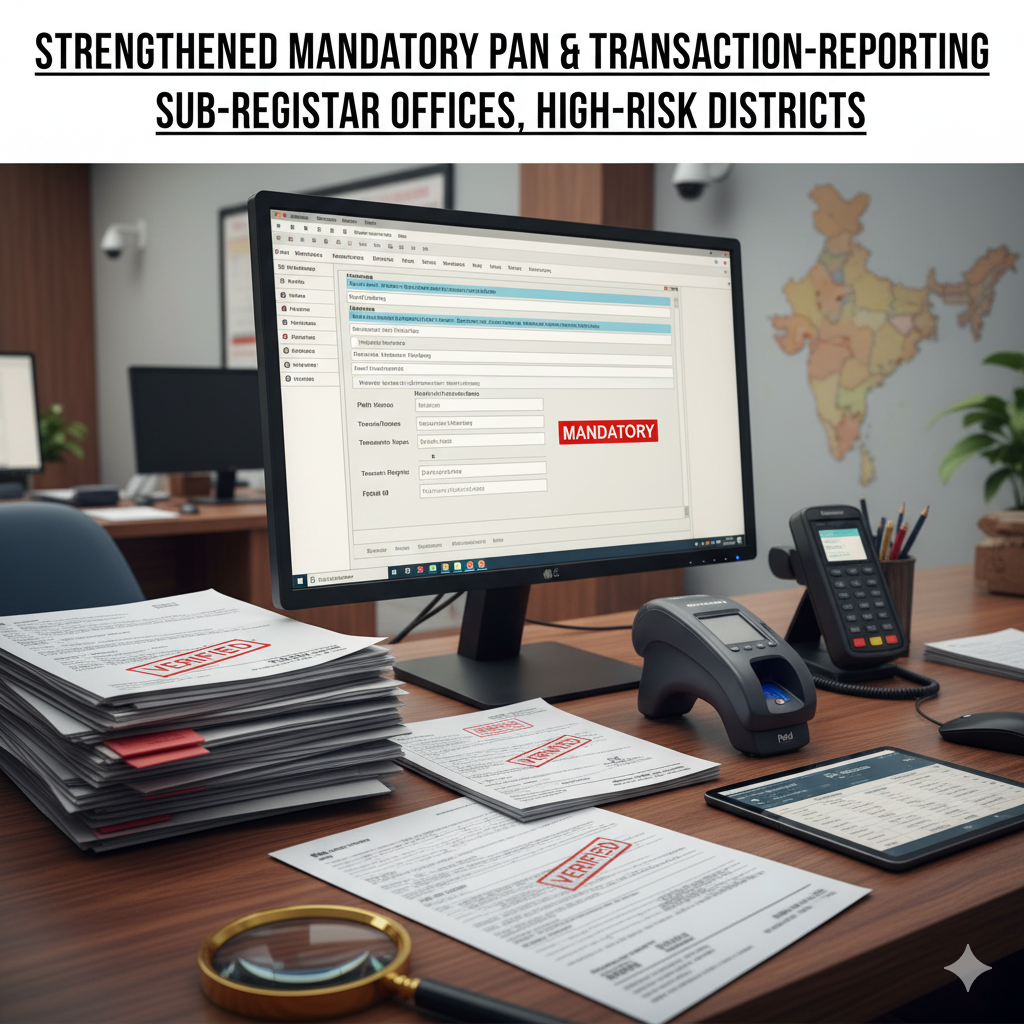
Strengthen mandatory PAN & transaction-reporting mechanisms at sub-registrar offices, especially in high-risk districts.
Deploy data-analytics by the IT Department to flag suspicious deals (high cash component, missing documentation, recurring large transfers).
Increase auditing and verification of property registries in border and rural areas.
Promote awareness among citizens: Insist on properly documented and disclosed property transfers, even if “everyone does cash deals”.
Create inter-state and cross-border coordination (especially where neighbouring countries/border zones enable grey flows).
What to watch
– Whether the IT Department pursues prosecutions or only warnings in these flagged cases.
– Whether state governments of Bihar and UP issue stricter instructions to sub-registrars and upgrade digital registry systems.
– Whether other states (especially in border regions) reveal similar patterns—this might indicate a national-level vulnerability rather than isolated districts.
– How property-price trends evolve in those border districts—does increased cash dealing cause rapid inflation or distortion?
– Over a three‐year span, approximately 600 transactions totalling over ₹250 crore were flagged for missing PAN details or failing to register data on property deals above ₹30 lakh.