

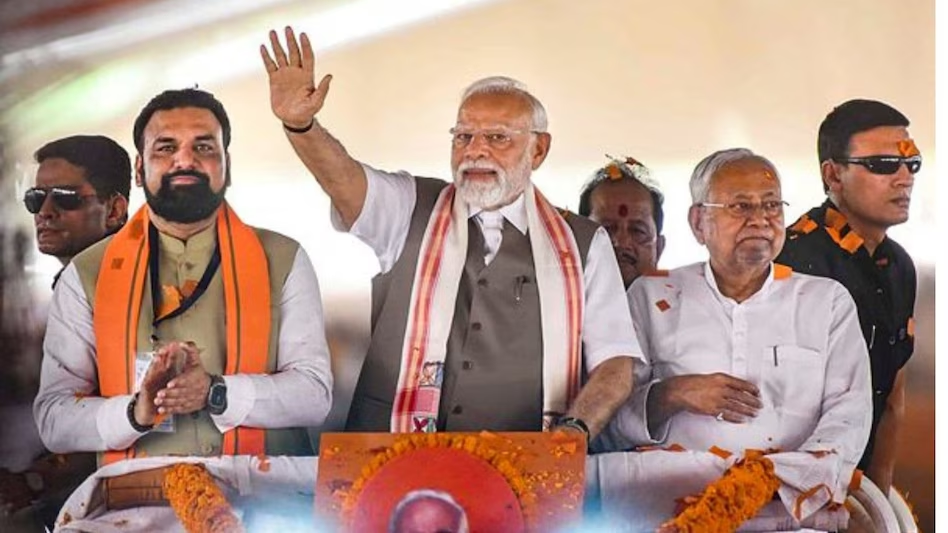
The 2025 Bihar Assembly election has delivered one of the most dramatic and decisive political outcomes in recent years, sending shockwaves through both state and national landscapes. The National Democratic Alliance (NDA) is heading toward a commanding, near-historic victory, securing well over 200 seats in the 243-member assembly. This is not just an electoral win — it is a political recalibration, a public message, and a reshaping of the Hindi heartland’s political balance.
For the wining party, this election represents a consolidation of power that builds upon previous cycles, while for the opposition Mahagathbandhan (MGB), it is a sweeping setback that has exposed deep strategic and structural flaws.
A Mandate That Speaks Loudly
Bihar has long been recognized as one of India’s most politically complex states — a place where caste formulas, ground mobilization, leadership charisma, and welfare politics intersect in unpredictable ways. A decisive win here signals not only public approval of governance but also confidence in the coalition’s long-term agenda.
The Wining party surge past the 200-seat mark is extraordinary for several reasons. In 2020, the alliance won 122 seats after a tough and competitive contest. The 2025 numbers show a dramatic shift in voter mindset, reflecting a demand for stability, continuity, and governance that feels predictable.
This kind of mandate is rare in Bihar, where fragmented voting patterns typically create close contests. This time, the electorate seems to have spoken in one clear voice.
Why the Opposition Lost Its Footing
The Mahagathbandhan’s collapse did not happen overnight. It was a result of tangled leadership, inconsistent messaging, and a failure to read the emotional undercurrent of Bihar’s voters.
The alliance attempted to build its campaign around themes of unemployment, local discontent, and allegations of administrative lapses. However, these issues lacked the punch needed to counter the NDA’s narrative of welfare delivery, infrastructure progress, and a stronger law-and-order presence.
The MGB’s strategy suffered from three major faults:
1. Confused Messaging
Leaders shifted between themes — from caste-based mobilization to anti-incumbency to allegations of electoral malpractice — without anchoring voters to a single, strong narrative.
2. Leadership Disconnect
While the NDA projected unified strength, the MGB struggled to present a cohesive or credible leadership face. Internal disagreements made them appear fragmented.
3. Poor Ground Mobilization
The NDA’s booth-level efforts were far more structured. In contrast, opposition cadres reported low morale and insufficient last-mile coordination.
The result was a campaign that failed to transform criticism into votes.
What Drove the NDA’s Mega-Win
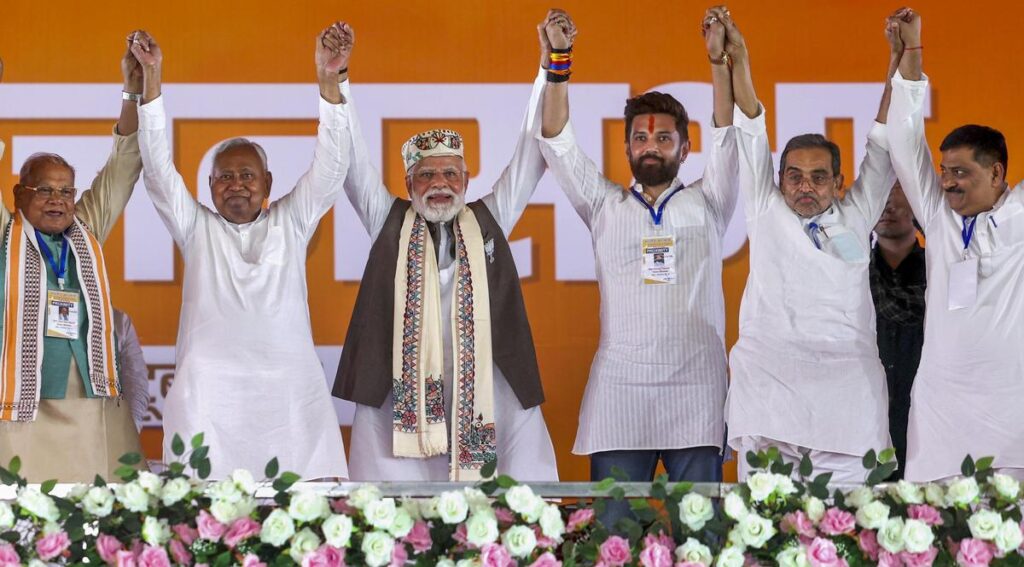
The NDA’s success can be attributed to a combination of governance outreach, organizational discipline, and strategic communication.
Strong Welfare Network
From direct benefit transfers to housing and rural schemes, the NDA effectively positioned itself as a provider of stability and support in difficult economic times.
Youth and Women Support
Bihar’s young voters, particularly first-time participants, appeared more aligned with development-centric appeals rather than caste arithmetic. Women voters, influenced by welfare initiatives and safety improvements, played a critical role in boosting the NDA’s vote share.
Security and Stability Narrative
Recent national and regional events heightened public interest in strong leadership. For many voters, the NDA symbolized assertiveness and continuity — two factors that typically generate confidence in volatile times.
A Political Ripple Felt Beyond Bihar
This election is not just a state phenomenon; it carries national implications. A massive mandate in Bihar strengthens the NDA’s strategic foothold across the Hindi heartland heading into future electoral cycles. States like Uttar Pradesh, Jharkhand, and Madhya Pradesh will likely feel the ripple effect as the NDA walks into 2026 with renewed momentum.
The opposition, meanwhile, faces an urgent need for reinvention. Bihar has served as a wake-up call signaling that fragmented alliances and old formulas may no longer resonate with an increasingly aspirational electorate.
What Comes Next for Bihar
With a stronger government now expected in Patna, policymaking and administration will be under intense public scrutiny. Voters will expect:
- Faster development in rural districts
- More aggressive job creation efforts
- Improved education and health infrastructure
- Stronger safety measures
- Continued welfare transparency
The mandate gives the NDA a powerful opportunity — and a heavy responsibility.
A New Chapter Begins
The 2025 Bihar verdict marks not just a shift in numbers but a shift in political psychology. Bihar’s voters have chosen clarity over confusion, continuity over chaos, and stability over experimentation. As the NDA prepares for its next chapter, one thing is clear: India’s political map has been redrawn with renewed force, and Bihar has once again proven why it remains one of the nation’s most influential electoral battlegrounds.