

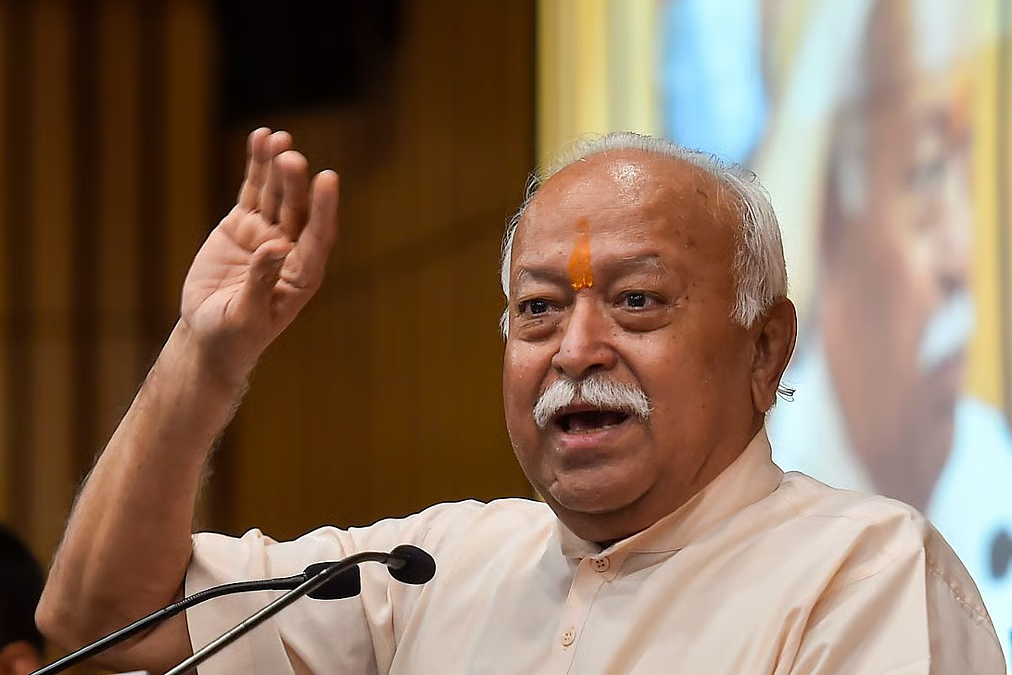
November 9, 2025, In a significant and thought-provoking address that has reignited a long-standing national debate, Rashtriya Swayamsevak Sangh (RSS) chief Mohan Bhagwat on Sunday asserted that the term “Hindutva” represents the true and inclusive essence of Indian identity far beyond the narrow connotations of religion. He argued that “Hinduism”, as commonly understood today, is a colonial construct that fails to capture the civilizational depth and cultural unity of India’s spiritual heritage.
Bhagwat’s remarks, delivered at an event organized by the RSS in Nagpur, have sparked widespread discussion across political, intellectual, and social circles. For some, it was a philosophical call to rediscover India’s indigenous roots; for others, it raised concerns about the reinterpretation of religious identity in political contexts.
“Hindutva is not exclusion, it is inclusion”
In his speech, Mohan Bhagwat explained that Hindutva is not merely about worship practices or religious boundaries it is about the “way of life” that defines the Indian ethos.
“Hindutva is a word that embraces all who love and respect this land, its culture, and its values,” he said.
“The British coined the word Hinduism to divide us into sects and identities. But Hindutva as Vivekananda and Savarkar envisioned represents the inclusive philosophy that unites us all.”
He emphasized that Hindutva should not be misunderstood as a political ideology but as a cultural and spiritual framework that welcomes every individual, regardless of faith or background. According to Bhagwat, the RSS’s idea of “Bharat” is one that recognizes diversity as strength and unity as destiny.
A call for self-realization and unity
Mohan Bhagwat’s comments come at a time when India is grappling with increasing polarization in religious and ideological spaces. His call to revisit the meaning of “Hindu” was positioned as a spiritual awakening rather than a political statement.
He noted that India’s greatest strength has always been its ability to assimilate and adapt, whether through Buddhism, Jainism, Sikhism, or even Islamic and Christian influences.
“Every person who considers India as their motherland and respects her culture is, in spirit, Hindu,” Bhagwat remarked. “Hindutva, therefore, is not about one religion; it is about one civilization.”
This redefinition seeks to establish Hindutva as a civilizational identity a broader, more universal concept that transcends dogma and ritual.
Reactions from across the spectrum
Mohan Bhagwat’s statement has drawn mixed reactions. Political analysts say the timing is strategic, given the upcoming elections in several key states.
While the BJP leadership largely welcomed the remarks as a reaffirmation of cultural nationalism, opposition parties accused the RSS of trying to “rebrand” religious ideology as cultural unity.
Several academics and historians have praised Bhagwat’s speech for its philosophical depth, comparing it to similar debates in post-colonial societies over reclaiming indigenous terminology. However, critics caution that such reinterpretations risk blurring the line between cultural identity and political ideology.
Social media, too, reflected this divide. On platforms like X (formerly Twitter), hashtags such as #HindutvaIsUnity and #RSSChiefSpeaks began trending, with users debating whether the term “Hindutva” should be associated with inclusivity or exclusivity.
Context and continuity
This is not the first time Mohan Bhagwat has sought to refine public understanding of Hindutva. In earlier speeches, he described it as “the soul of Indian culture”, emphasizing compassion, service, and mutual respect.
The RSS, founded in 1925, has consistently maintained that its ideology centres on building a strong, united nation grounded in cultural pride. Bhagwat’s latest address coincides with the organization’s centenary year preparations, signalling a renewed push to connect with India’s youth on cultural and philosophical grounds rather than pure politics.
The deeper meaning behind the message
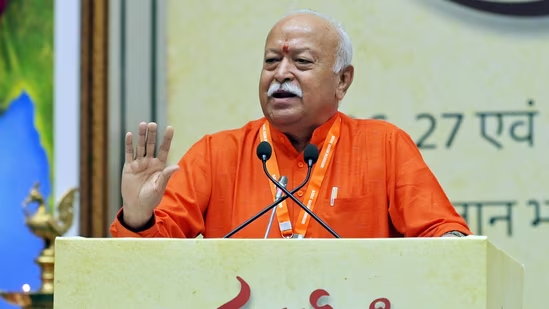
Experts suggest that Bhagwat’s remarks are aimed at reshaping global perceptions of Hindutva. In the West, the term is often associated with religious nationalism; Bhagwat’s speech, however, sought to portray it as a humanistic and pluralistic concept rooted in ancient Indian thought.
In essence, his statement attempts to reclaim linguistic and cultural ownership: if Hinduism was defined by outsiders, Hindutva is to be defined by Indians themselves.
Conclusion: A civilizational shift in discourse
Mohan Bhagwat’s bold articulation may mark a turning point in India’s cultural conversation. Whether one agrees with his interpretation or not, it undeniably revives a crucial dialogue about identity, history, and belonging.
In redefining Hindutva as a philosophy of unity rather than division, Bhagwat is not merely revisiting the past he is challenging India to imagine a future where spiritual and cultural coherence transcends sectarian divides.
As India approaches its next century of independence, his message serves as both a reminder and a question: Can Hindutva truly evolve into a universal Indian identity without losing its essence?