


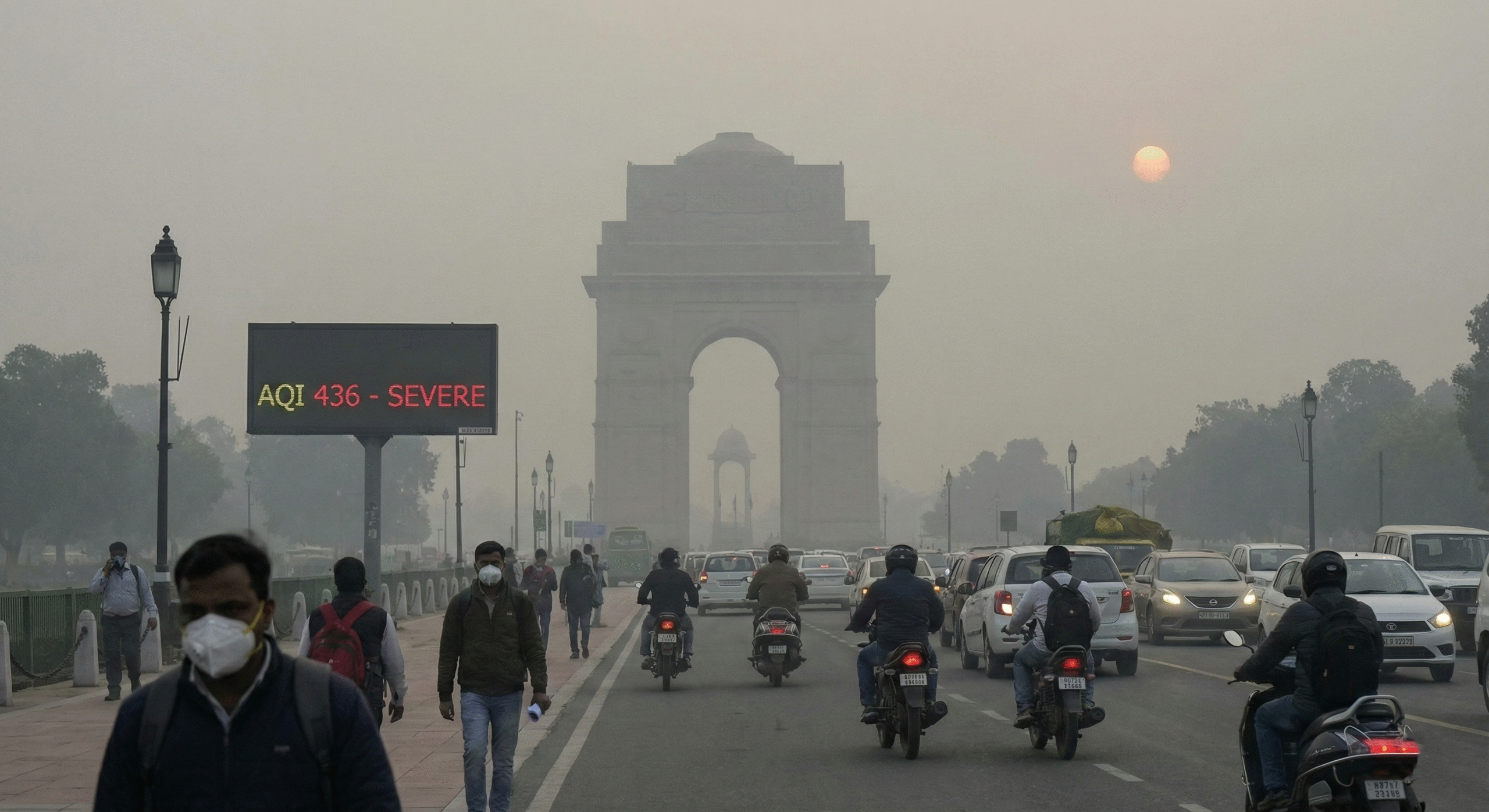
December 3, 2025 – New Delhi has once again woken up to a gray, choking reality. Just days after a brief spell of relatively cleaner air offered a glimmer of hope to the capital’s millions of residents, the toxic haze has returned with a vengeance. As of early Wednesday morning, the city’s overall Air Quality Index (AQI) is hovering dangerously close to the “severe” category, while several neighborhoods have already breached the 400-mark, effectively turning vast swathes of the metropolis into an open-air gas chamber.
The reprieve felt in late November, when strong winds briefly flushed out pollutants, now feels like a distant memory. On December 3, the Central Pollution Control Board (CPCB) reported an alarming spike in pollution levels. While the citywide average stood at a “very poor” 376, the ground reality in specific pockets is far grimmer. Nehru Nagar emerged as the most polluted hotspot with an AQI of 436, followed closely by the bustling lanes of Chandni Chowk at 431, and the residential hubs of R.K. Puram and Rohini, which recorded levels of 420 and 417 respectively.
The Anatomy of the Smog
This current deterioration is not being driven by the usual suspect of stubble burning, which dominated the discourse in October and November. Instead, meteorology and local emissions have formed a “toxic cocktail.” As winter settles in, Delhi’s minimum temperatures have dipped significantly, hovering around 9°C. This drop in temperature, combined with calm surface winds, has created a phenomenon known as “temperature inversion.” essentially trapping pollutants close to the ground. The dispersion that usually happens with wind and heat is absent, leaving the city to stew in its own emissions.
Data indicates that local sources are now the primary drivers of this pollution. Vehicular emissions are currently contributing over 18% to the city’s pollution load. With the wedding season in full swing and traffic congestion peaking, the sheer volume of idling vehicles is pumping nitrogen oxides and particulate matter into an atmosphere that has no capacity to absorb them.
A Public Health Emergency
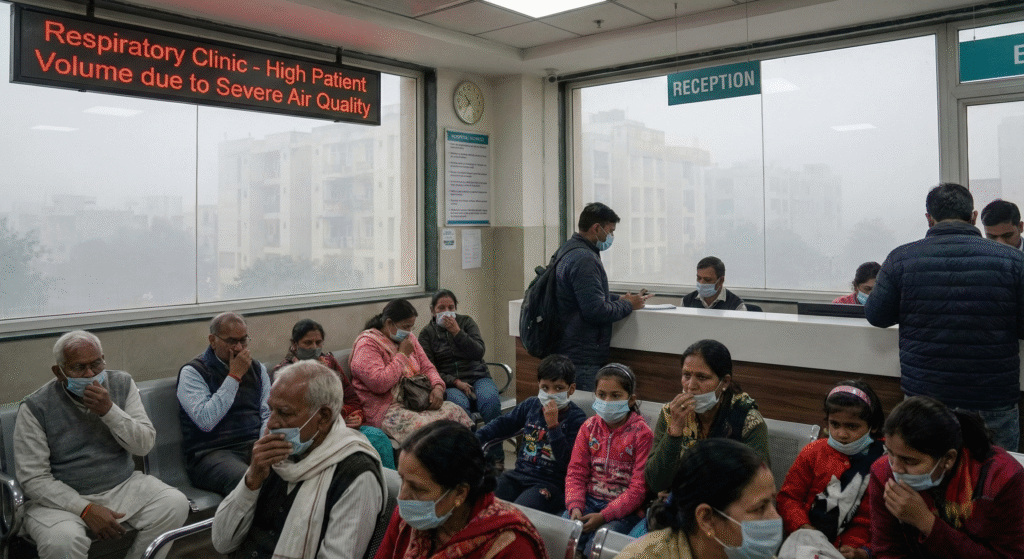
For the average Delhiite, these numbers translate into immediate physical discomfort. A walk down Kartavya Path or near India Gate today reveals a dystopian scene; landmarks that usually gleam in the winter sun are shrouded in a thick, acrid mist. Visibility has dropped significantly, slowing traffic and forcing commuters to switch on headlights in the middle of the day.
Hospitals are reporting a surge in patients complaining of breathlessness, burning eyes, and persistent coughs. The “severe” category AQI—anything above 400—is defined as air that affects healthy people and seriously impacts those with existing diseases. Yet, life in the capital trundles on. With schools recently reverting to offline classes after the revocation of GRAP Stage III restrictions, millions of children are once again being exposed to hazardous air during their morning commute.
Policy Whiplash
The return of severe pollution has raised serious questions about the sustainability of the current regulatory framework. Just days ago, the Commission for Air Quality Management (CAQM) lifted the strict Stage III measures of the Graded Response Action Plan (GRAP), citing an improvement in the AQI. The decision allowed construction activities to resume and schools to reopen physically.
However, the rapid slide back into the “severe” zone suggests that these reactive measures may be insufficient against the city’s chronic pollution baseline. Critics argue that the “yo-yo” approach—imposing bans when the air turns poisonous and lifting them the moment it improves slightly—fails to address the root causes. There is now renewed pressure on authorities to potentially reimpose stricter curbs if the AQI remains above 400 for another 24 hours.
Looking Ahead
The forecast offers little comfort. The India Meteorological Department (IMD) has predicted that wind speeds will remain low for the next few days, meaning the pollutants currently trapped over the city are unlikely to disperse. Furthermore, with a potential cold wave approaching later this week, the atmospheric “lid” over Delhi could tighten further.
As the sun struggles to pierce through the smog today, the mood in the capital is one of resignation and frustration. The conversation has shifted from “if” the air will turn bad to “how long” residents must endure it. For now, Delhi is once again a city holding its breath, waiting for the wind to blow.