
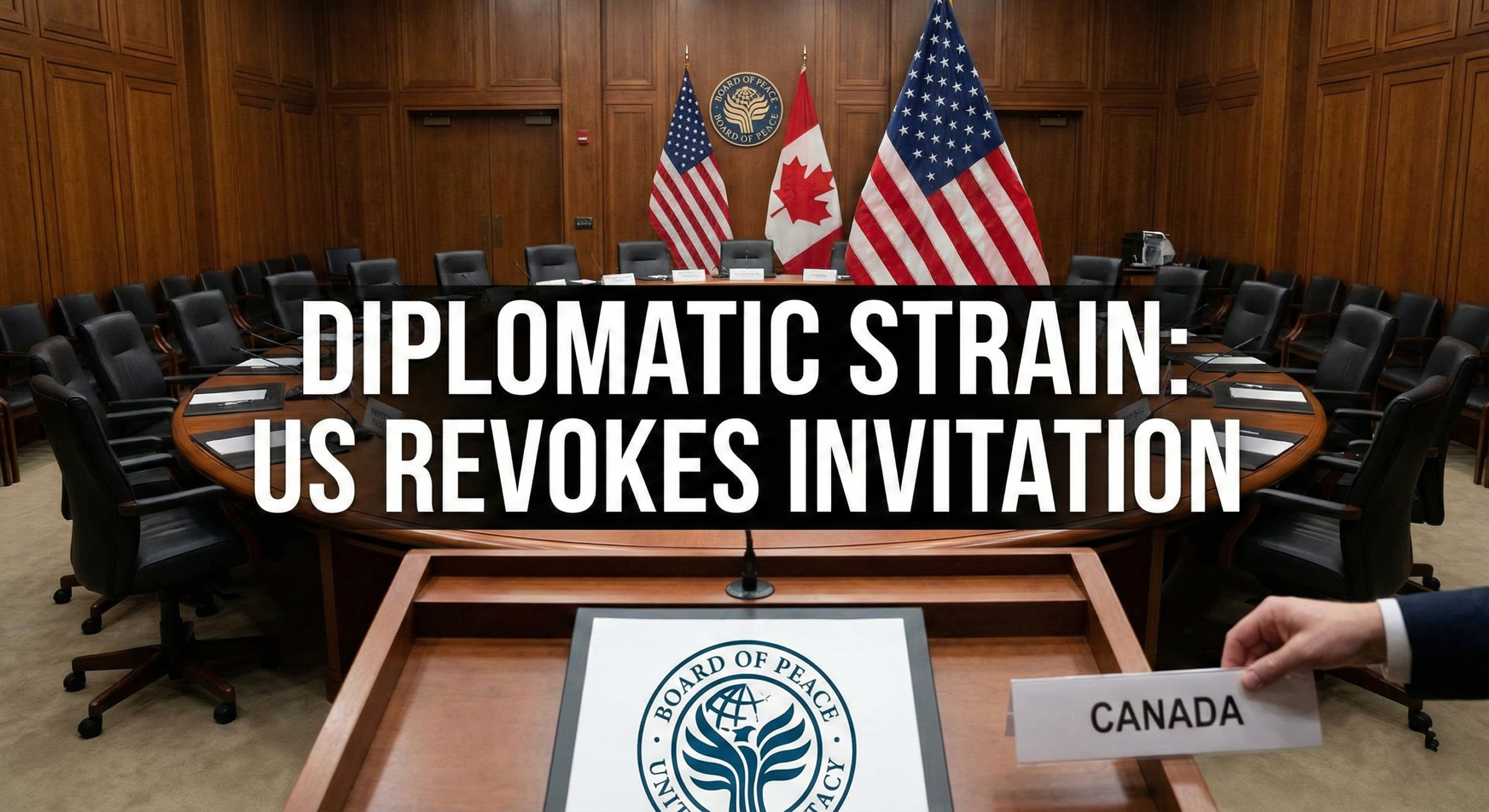
Washington / Davos – U.S. President Donald Trump has withdrawn Canada’s invitation to join the newly proposed Board of Peace, triggering fresh diplomatic tensions between two of America’s closest allies and raising questions about the future of the controversial global initiative.
The decision came shortly after a sharp exchange between Trump and Canadian Prime Minister Mark Carney at the World Economic Forum (WEF) in Davos, where global leaders gathered to discuss international stability, economic cooperation, and conflict resolution. Trump’s move has drawn international attention, not only because of the abrupt nature of the revocation, but also because it highlights deep disagreements over how global peace efforts should be structured and led.
What Is the Board of Peace?
The Board of Peace is a proposed international body announced by Donald Trump during his appearance at the World Economic Forum. According to Trump, the board is designed to support peace negotiations, oversee ceasefire efforts, and assist in post-conflict reconstruction — initially focusing on Gaza, with plans to expand to other global conflict zones.
Trump described the Board of Peace as an “elite group of global decision-makers” and suggested that member nations would contribute significant financial resources to participate. While Trump positioned the initiative as a bold alternative to traditional multilateral institutions, critics quickly questioned its transparency, cost, and overlap with existing organizations such as the United Nations.
Several countries, including Argentina, Turkey, Pakistan, Bahrain, and Morocco, were named as early participants or supporters. However, many long-standing U.S. allies, including Canada, France, Germany, and the United Kingdom, have shown hesitation or declined to commit.
Why Was Canada’s Invitation Revoked?
Canada’s removal from the Board of Peace was widely linked to Prime Minister Mark Carney’s speech at Davos, where he emphasized the importance of a rules-based international order and warned against global institutions being dominated by a small group of powerful nations.
Although Carney did not mention Trump directly, his remarks were interpreted as a criticism of Trump’s vision for the Board of Peace. Shortly after the speech, Trump publicly responded, accusing Canada of undermining U.S. leadership and questioning Ottawa’s commitment to American-led global initiatives.
Within hours, Trump announced that Canada’s invitation to join the Board of Peace had been withdrawn, stating that the country’s leadership had shown “a lack of respect” for the initiative’s goals.
The move was particularly striking because Canada had not formally accepted the invitation and had reportedly expressed concerns about the board’s structure and financial expectations.
Canada’s Response
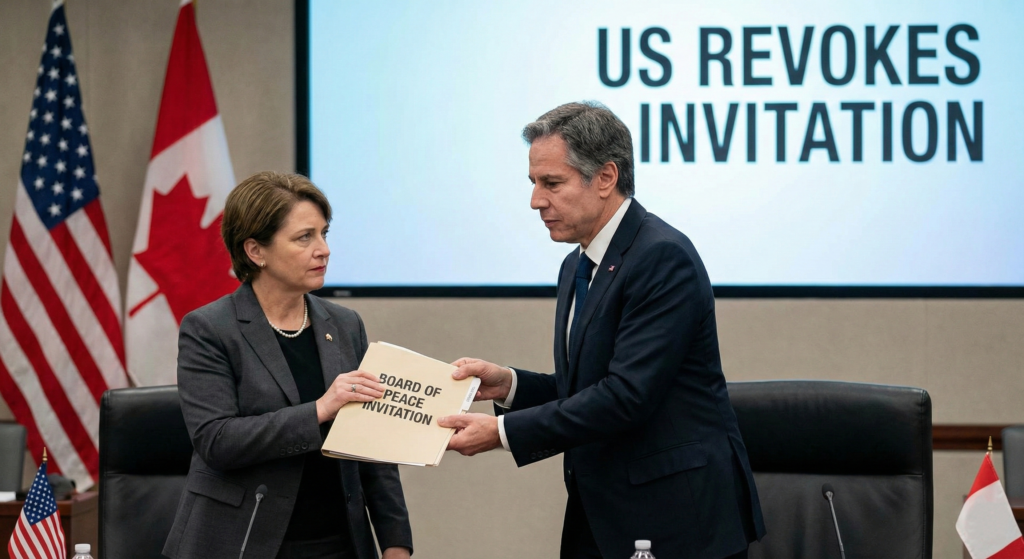
Prime Minister Carney responded firmly but diplomatically, defending Canada’s sovereignty and its right to express independent views on global governance. He reiterated that Canada supports peace initiatives that are inclusive, transparent, and internationally accountable, rather than centered around unilateral leadership.
Canadian officials downplayed the significance of the withdrawal, emphasizing that Canada remains committed to multilateral diplomacy through established international frameworks. Still, analysts note that the incident reflects a growing strain in U.S.–Canada relations amid shifting global power dynamics.
Why This Matters Globally
The revocation of Canada’s invitation is more than a bilateral dispute — it has broader implications for global diplomacy.
First, it raises questions about the credibility and viability of the Board of Peace. Without the participation of major Western allies, the initiative may struggle to gain legitimacy or operational effectiveness.
Second, the episode underscores growing divisions among democracies over how peacekeeping and conflict resolution should be managed. While Trump advocates for a centralized, leader-driven approach, countries like Canada continue to push for multilateral consensus and institutional oversight.
Third, the controversy highlights concerns that the Board of Peace could weaken existing international systems by creating parallel structures rather than strengthening current ones.
Political and Strategic Implications
For Trump, the move reinforces his image as a leader willing to take decisive — and sometimes confrontational — action in global affairs. Supporters see it as proof of strong leadership, while critics argue it risks alienating allies and complicating diplomatic cooperation.
For Canada, the incident may actually strengthen its standing among countries wary of unilateral global initiatives. By standing firm, Ottawa positions itself as a defender of traditional multilateral diplomacy.
What Happens Next?
It remains unclear whether the Board of Peace will gain wider international support or remain a symbolic initiative with limited influence. Much will depend on whether additional countries join and how the board’s role is defined in relation to existing global institutions.
As global conflicts continue to demand coordinated solutions, the dispute between Trump and Canada serves as a reminder that how peace is pursued can be just as contentious as the conflicts themselves.