


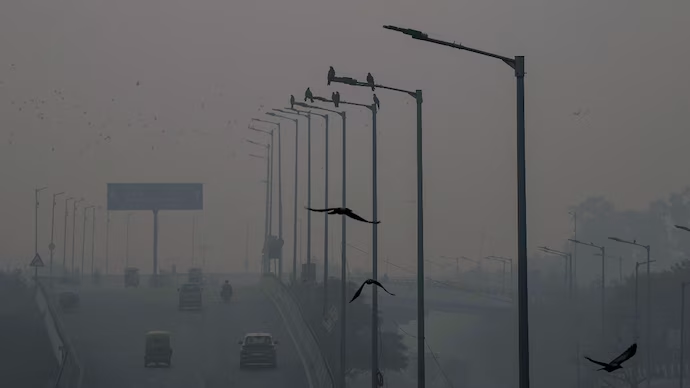
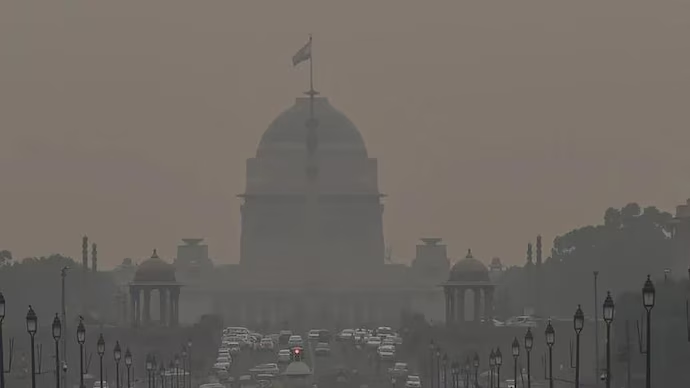
New Delhi | November 7, 2025 — Delhi woke up this morning under a grey haze thick enough to blur the skyline, as the Air Quality Index (AQI) shot up to 329, placing the national capital once again in the “Very Poor” category. According to data from the Central Pollution Control Board (CPCB), the pollution levels across most monitoring stations have spiked sharply since Thursday night, signalling the city’s continuing struggle with seasonal smog and stagnant wind conditions.
Toxic Morning for Millions
Residents across areas like Anand Vihar, RK Puram, ITO, and Rohini reported burning eyes, dry throats, and difficulty breathing during morning commutes. The dense smog layer, visible even after sunrise, reduced visibility on major highways and delayed several domestic flights at Indira Gandhi International Airport.
Doctors have once again sounded the alarm. Dr Randeep Guleria, former AIIMS director, warned that “such air quality levels are equivalent to smoking 15–20 cigarettes a day.” He added that children, elderly citizens, and people with respiratory or cardiac conditions should avoid prolonged outdoor activity.
The Meteorological Factor
The India Meteorological Department (IMD) attributes the sharp deterioration to calm winds and falling nighttime temperatures, which trap pollutants near the surface. A shallow fog layer has been preventing dispersion since mid-week, allowing vehicular exhaust, industrial emissions, and construction dust to accumulate.
IMD scientist R. K. Jenamani stated, “The next 48 hours are critical. Unless there is a change in wind direction or light rainfall, the smog is likely to persist.”
Forecasts suggest a mild improvement by Sunday as north-westerly winds strengthen, but pollution may spike again early next week with continued farm-fire activity in neighboring Punjab and Haryana.
Stubble Burning: The Annual Villain
Satellite images from NASA’s FIRMS platform show over 2,300 active fire points in Punjab and Haryana over the last 48 hours — a steep rise compared with last week. These farm fires, part of the annual crop-clearing cycle, send plumes of smoke drifting toward Delhi-NCR, combining with local emissions to form a toxic cocktail of PM 2.5 and PM 10 particles.
The Commission for Air Quality Management (CAQM) has urged northern states to intensify enforcement against residue burning and promote in-situ management technologies. Punjab officials, however, maintain that limited equipment and financial constraints hamper farmers’ ability to switch to sustainable alternatives.
Emergency Measures Rolled Out
In response, the Delhi government re-activated several emergency steps under Stage III of the GRAP (Graded Response Action Plan):
- Ban on construction and demolition activities (except essential public projects).
- Restrictions on diesel generators across NCR regions.
- Sprinkling of water and mechanical sweeping intensified on arterial roads.
- Odd-even traffic plan being reviewed for possible re-implementation if levels continue to rise.
Environment Minister Gopal Rai said the government is “closely monitoring the situation” and will not hesitate to impose stricter curbs if air quality enters the “Severe” zone. “We urge residents to use public transport, carpool, and avoid burning waste in open areas,” he appealed.
Public Health Concerns Grow
Schools across several districts are considering temporary online classes. The Delhi Health Department has advised hospitals to keep emergency units ready for an increase in respiratory and cardiac cases.
Pharmacies in areas like Lajpat Nagar and Dwarka have reported a sudden spike in sales of inhalers and N95 masks. Joggers’ parks and open gyms that buzz with morning activity now appear nearly deserted.
Dr Aruna Sharma, a pulmonologist at Safdarjung Hospital, observed: “We are witnessing a seasonal health crisis that repeats every year. Without structural reforms — cleaner fuel, reduced road congestion, and regional cooperation — Delhi will remain a gas chamber each winter.”
Long-Term Outlook
Experts insist that short-term bans cannot replace long-term planning. Sustainable urban transport, renewable-energy integration, strict emission norms for industry, and coordinated action with neighboring states are vital.
A 2025 report by the Centre for Science and Environment (CSE) notes that Delhi’s winter pollution has worsened by nearly 9 percent compared to 2023, largely due to “uncontrolled regional pollution sources and weak enforcement.”
A Breath of Hope?
Some citizens’ groups and schools are organizing awareness drives and indoor-planting campaigns to counter the gloom. Air-purifier sales have surged across the NCR region, but many low-income residents remain vulnerable.
For Delhi’s 30 million residents, the smog is no longer news — it’s a recurring emergency. The question is not whether the air will clear this week, but whether the city and its neighbors can finally commit to making clean air a permanent right rather than a seasonal luxury.