



By [back24hours.com] | November 5, 2025 India’s political climate ignited again this week after Congress leader Rahul Gandhi accused H-Files the Election Commission (EC) and the Bharatiya Janata Party (BJP) of manipulating the results of the Haryana Assembly elections. Gandhi’s claims, dubbed the “H-Files” controversy, have thrown the spotlight on India’s electoral integrity and triggered a war of words between the ruling and opposition camps.
The ‘H-Files’ Claim: What Rahul Gandhi Said
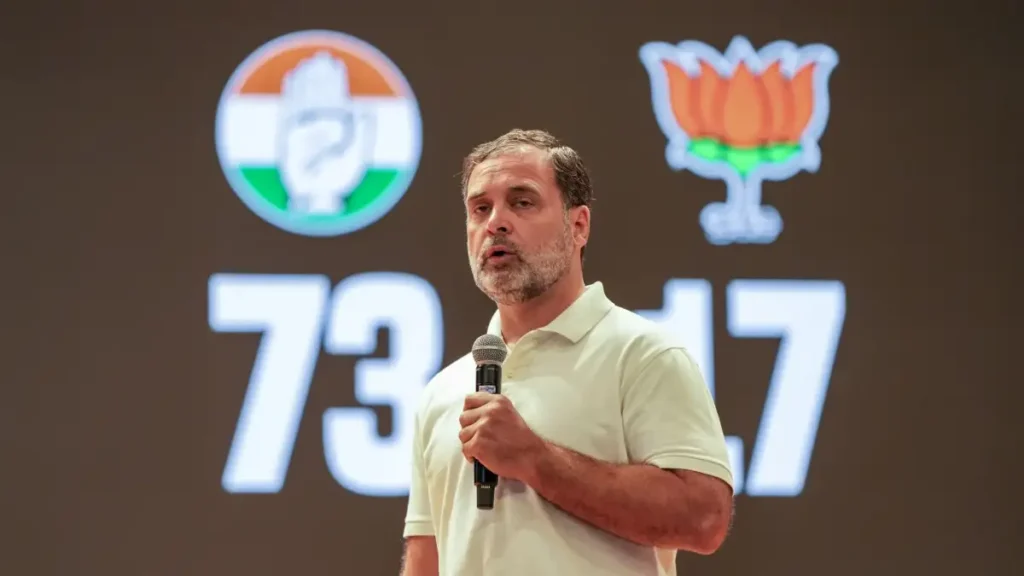
During a fiery press conference in New Delhi on Tuesday, Gandhi claimed that his party had obtained documents proving “coordinated irregularities” in several constituencies during the Haryana polls.
He alleged that EVM (Electronic Voting Machine) data and postal ballots were tampered with to ensure a BJP victory in key seats.
“These are not ordinary mistakes. These are patterns. We are calling them the ‘H-Files’ — Haryana Files — evidence of how democracy is being compromised,” Gandhi said, holding what he described as internal documents and vote-count reports.
He further demanded that the Election Commission conduct an independent audit of the counting process and release detailed constituency-level data.
BJP’s Swift Response: “Baseless, Desperate Politics”
The BJP wasted no time in hitting back. Party spokesperson Sambit Patra dismissed the accusations as “manufactured drama” aimed at diverting attention from Congress’s poor electoral performance.
“The people of Haryana have rejected the Congress, not democracy,” Patra said. “Rahul Gandhi’s so-called ‘H-Files’ are nothing but fiction. Even his party workers are questioning his leadership.”
Several BJP leaders pointed out that the Election Commission operates as an independent constitutional body, and any claims of bias must be supported by verifiable evidence.
Election Commission Breaks Its Silence
In an unusual move, the Election Commission of India issued a statement late Wednesday evening, rejecting the allegations outright. It said that all voting data, including EVM and postal ballot records, had been transparently recorded and monitored under the supervision of both party agents and independent observers.
“The counting process in Haryana was conducted in accordance with all legal provisions,” the EC statement read. “Any doubts can be addressed through established legal mechanisms.”
The Commission also warned against spreading “unverified and potentially misleading claims” that could erode public trust in democratic institutions.
Public Reaction: Split Between Trust and Suspicion
The controversy has split public opinion sharply. On social media platform X (formerly Twitter), the hashtag #HFiles trended throughout the day. Congress supporters rallied behind Gandhi’s call for “truth and transparency,” while BJP backers accused him of undermining India’s democracy.
Many citizens expressed frustration that every major election now seems followed by mutual accusations of vote manipulation or EVM tampering, reflecting growing political mistrust across party lines.
Political analysts suggest that this episode could deepen polarization ahead of the 2026 General Elections, especially as Congress seeks to rebuild its credibility after consecutive electoral setbacks.
Democracy Under Question — or Strengthened by Debate?
Experts are divided on the larger implications. Some see Gandhi’s allegations as a necessary act of accountability, urging greater openness in the electoral process. Others warn that repeated unproven charges risk damaging public confidence in one of the world’s largest and most complex voting systems.
Dr. Meera Krishnan, a political science professor at Delhi University, said:
“Healthy skepticism is good for democracy, but we must distinguish between transparency and theatrics. The Election Commission remains one of India’s most respected institutions, and weakening it through speculation could have long-term consequences.”
What Happens Next
The Congress Party has stated that it will submit the “H-Files” to the Supreme Court if the Election Commission does not open an inquiry within two weeks.
Meanwhile, BJP leaders have urged Rahul Gandhi to make the documents public — or apologize for what they call “defamatory politics.” As the debate intensifies, one thing is clear: the “H-Files” have reignited a national conversation about electoral credibility, institutional trust, and the role of opposition politics in India’s democracy.
Conclusion
Whether the “H-Files” turn out to be a political masterstroke or a misstep, they have already reshaped the public narrative.
In an age when truth competes with viral politics, India’s democracy is once again being tested — not just at the ballot box, but in the battle of belief.